
Modern Braces
Precision appliances. Personalized care. Beautiful smiles at every age.
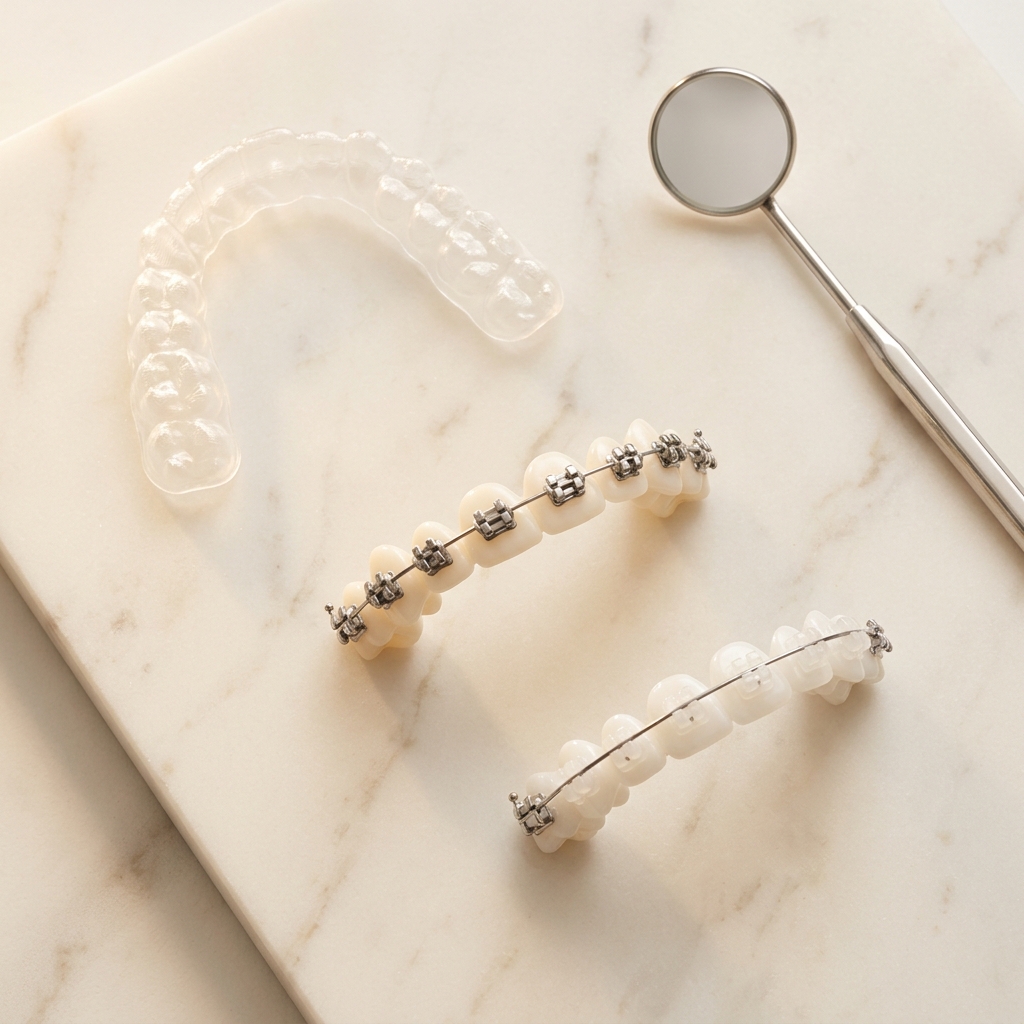
Types of Braces
Our practice utilizes the latest technology, offering a variety of safe and gentle treatment options to give you the customized, individual care you deserve. Dr. Lee or Dr. Jung will recommend the best system for your case during your complimentary consultation.
- Invisalign®: A series of clear, removable aligners that straighten your teeth. You can eat and drink whatever you like, and brush and floss normally. Invisalign® is made with SmartTrack® material, which reshapes your smile one aligner at a time in the most comfortable way possible. Treatment is fully customized for each individual. Learn more about Invisalign® →
- Traditional Metal Braces: Made of high-grade stainless steel with the option of adding colored elastics (rubber bands) for a more unique and colorful smile. These braces are used for our Phase 1 patients.
- Metal Self-Ligating Braces: Made from the same materials as traditional braces, but self-ligating braces do not require the use of elastics, meaning fewer appointments and less friction being placed on the tooth. The specialized clip helps reduce the amount of pressure and requires fewer adjustments, helping the archwire guide teeth into place.
- Clear Self-Ligating Braces: Made of clear materials and therefore less visible on your teeth than metal braces. Clear braces are used mainly on teenagers and adult patients who have cosmetic concerns. While they are visually less prominent, they do require more attention to oral hygiene as clear braces are slightly more brittle than their metal counterparts.
At Vivian Lee Orthodontics in Arcadia, we offer the full spectrum of modern orthodontic appliances—from Invisalign clear aligners to traditional metal, metal self-ligating, and clear self-ligating braces. Dr. Lee and Dr. Jung will recommend the best system for your specific case during your complimentary consultation.
Frequently Asked Questions
What is the difference between traditional braces and self-ligating braces?
Traditional metal braces use elastic ties—the colored rubber bands—to hold the archwire against each bracket. Self-ligating braces use a built-in sliding clip mechanism instead, which reduces friction and typically results in fewer adjustment appointments and less overall pressure during treatment. Both options achieve excellent results; the right choice depends on your case and preferences.
Are clear (ceramic) braces as effective as metal?
Yes—clear self-ligating braces move teeth just as effectively as metal brackets. They are slightly more brittle, which is why they're typically recommended for older teens and adults who are diligent about oral hygiene. For Phase One patients (younger children), Dr. Lee generally recommends metal brackets for durability.
Do braces hurt?
You may experience mild soreness for a few days after getting braces and after adjustments. This is normal and can be managed with over-the-counter pain relievers like ibuprofen. We also provide orthodontic wax to ease any irritation on your cheeks or lips.
How long will I need to wear them?
Every smile is different. Comprehensive treatment usually takes 12 to 24 months, but some minor corrections take only 6 months. We will provide a specific timeline at your complimentary consultation.
What foods should I avoid with braces?
You should avoid hard, sticky, or chewy foods that can break brackets or bend wires. This includes ice, nuts, hard candies, caramel, and chewing gum. Healthy foods like apples and carrots should be cut into bite-sized pieces.
Can I still play sports or a musical instrument?
Yes. We recommend wearing an orthodontic mouthguard for contact sports. For wind instruments, it may take a few days to adjust, but your braces will not stop you from playing.
Do you offer free consultations to discuss which braces are right for me in Arcadia?
Yes—all new patient consultations at Vivian Lee Orthodontics are complimentary. Dr. Lee or Dr. Jung will review your teeth, jaw, bite, and aesthetic goals, then walk you through which treatment options best fit your clinical needs and lifestyle.
Braces for All Ages
Every smile is unique. Explore how we tailor orthodontic care to each stage of life.
Why Age 7?
The American Association of Orthodontists recommends visiting the orthodontist by age seven. By this age, most children have a mix of baby teeth and adult teeth, making it easier for the orthodontist to diagnose and correct tooth and jaw problems sooner — and without surgery.
What Early Treatment Can Achieve
Early treatment allows your orthodontist to:
- Correct and guide the growth of your child's jaw to help permanent teeth come in straight
- Regulate the width of the upper and lower arches
- Create more space for crowded teeth
- Avoid the need for permanent tooth extractions later in life
Signs Your Child May Be Ready
For parents, it's not always easy to know if your child may need orthodontic treatment. Here are a few things to look for:
- Early or late loss of baby teeth
- A hard time chewing or biting food
- Mouth breathing
- Finger or thumb sucking
- Crowded, misplaced, or blocked teeth
- Teeth that come together abnormally, or do not come together at all
- Jaws and teeth that are not proportionate to the rest of the face
Early treatment now will give your child a healthy, beautiful smile for the future.
Book Free ConsultOrthodontics Isn't What It Used to Be
Don't worry — Invisalign and braces aren't nearly as scary as you may think! In fact, orthodontic treatment today is much easier, more comfortable, and even more stylish than in the past.
How Long Will Treatment Take?
The amount of time it takes to treat your smile depends on three key factors:
- Early treatment: Early treatment allows orthodontists to monitor the growth of the jaw and recommend further orthodontic treatment if it becomes necessary. Not everybody receives early orthodontic treatment; in some cases it may be recommended that a patient wait to receive treatment.
- What needs correction: Different patients react to treatments differently. While it may take one patient only 12 months to complete treatment, it may take another patient 24–30 months. Treatment times can vary depending on how quickly your body responds and how much work is needed to give you the show-stopping smile you expect.
- You! Your willingness to use the appliances your orthodontist gives you plays a major role in the length of time it takes to complete your treatment. Always remember to take care of your Invisalign, braces, and appliances — this truly will help make your treatment shorter!
Orthodontics Your Way
Our practice offers a variety of treatment options to choose from:
- Invisalign
- Metal self-ligating braces
- Clear self-ligating braces
Orthodontic treatment is a big part of life for many people your age. While braces may have had a bad reputation in the past, today's Invisalign and self-ligating braces make it easy to look good and feel good!
Book Free ConsultIt's Never Too Late
Orthodontic treatment is not just for teens. In fact, the American Association of Orthodontists states that one in five orthodontic patients is over the age of 21. Many adults are choosing to receive treatment because they understand the importance of maintaining their health, and they want to feel better about their appearance. Adults everywhere are taking advantage of the opportunity to receive orthodontic care, and now you can too.
Common Reasons Adults Consider Treatment
- A bad bite or malocclusion, causing teeth to fit together incorrectly
- Teeth are crowded or spaced apart, possibly causing tooth decay or gum disease
- Abnormal jaw pain, or pressure that is caused by crooked teeth
- Desire for a healthier mouth and a more confident smile
Treatment Options for Adults
For many adults, the thought of having metal braces is enough to discourage them from receiving treatment. However, today's orthodontic treatment options offer a variety of choices that are comfortable, aesthetic, and customized to meet your needs:
- Invisalign
- Clear self-ligating braces
- Metal self-ligating braces
How Adult Treatment Differs
The main difference when treating adults versus children and teens is that in younger patients the jawbones are still developing. For adults, these bones have stopped growing, which may mean the possibility of orthognathic surgery to align the jawbones. Other differences include:
- Gum or bone loss (periodontal disease): Adults are more likely than children to experience gum recession or even bone loss due to gingivitis or advanced periodontal disease. Patients with straighter teeth are less likely to get gum disease.
- Worn or missing teeth: Over time teeth can become worn down and shift into different positions that can only be corrected with orthodontic care. Missing teeth can cause other teeth to shift and tilt, creating a bad bite and increasing the possibility of gum disease.
- Incomplete orthodontic treatment as a teen: Many adults received some orthodontic treatment as a child or teen, but never completed their treatment. As an adult, they choose to complete their orthodontic treatment to achieve the healthy, beautiful smile they always wanted.
Our practice recognizes that adults and children have different needs and require a different level of attention and care. We will work with you to ensure that you receive the most appropriate treatments, and that your needs are met with understanding and respect.
Why Consider Orthodontic Treatment?
- Straight teeth are healthy teeth: Teeth that are properly aligned are easier to keep clean with flossing and brushing, and may help prevent other health problems.
- A beautiful, straight smile builds confidence: Orthodontic treatment can help boost your self-confidence, giving you a better quality of life and the freedom to smile without holding back!
- Mouths left untreated can get worse: Not receiving orthodontic treatment when it's needed can create long-term health issues costing you more in the end.
We understand that you have a busy schedule, and we will work with you to make sure each office visit is as convenient as possible. Our Arcadia office proudly serves patients seeking braces from Pasadena, San Gabriel, La Verne, San Marino, and Sierra Madre.
Book Free Consult
Two-Phase Treatment
It is recommended by the American Association of Orthodontists for children to have their first orthodontic check-up by age seven.
Two-phase orthodontic treatment consists of two separate times when a child receives orthodontic treatment. The first phase begins when a child has a mix of baby and adult teeth and early intervention has been recommended by the doctor to prevent a problem from developing, intercept a developing problem, and/or guide the growth of the jaw bones that support the teeth.
What if treatment is put off?
Putting off treatment can result in a need for more invasive treatment later in life that may not completely fix your child's smile. Early treatment is most effective for achieving lasting results.
Phase One — Foundation
The goal of Phase One treatment is to help the jaw develop in a way that will accommodate all of the permanent teeth and improve the way the upper and lower jaws fit together. Children often exhibit early signs of jaw problems as they grow and develop. An upper jaw that is growing too much or is too narrow can be recognized at an early age. If children over the age of six are found to have this jaw discrepancy, they are candidates for early orthodontic treatment. Also, if children have crowded front teeth, early treatment can prevent the need to extract permanent teeth later.
- Planning now can save your child's smile later: Children benefit tremendously from early-phase treatment. Receiving early treatment may prevent the removal of permanent teeth later in life, or the need for surgical procedures to realign the jaws, or guide in impacted teeth.
- Making records to determine your child's unique treatment: Orthodontic records will be necessary to determine the type of appliances to be used, the duration of treatment time, and the frequency of visits. Records consist of digital models of the teeth, X-rays, and photographs. During your child's initial consultation, the doctor will take records to determine if early treatment is necessary.
Phase One treatment can be done with Invisalign First, metal braces, or clear braces.
Growth & Development / Observation Period
Once the goals of Phase One treatment have been met, one set of retainers will be provided. We will monitor the growth and development of the remaining adult teeth every four to six months until Phase Two treatment is recommended to begin.
Phase Two — Comprehensive
The goal of the second phase is to make sure each tooth has an exact location in the mouth where it is in harmony with the lips, cheeks, tongue, and other teeth. When this equilibrium is established, the teeth will function together properly. Phase Two usually involves full upper and lower Invisalign or braces.
The American Association of Orthodontists recommends that children receive their first orthodontic check-up by age seven—and at our Arcadia practice, we take that recommendation seriously. Two-phase orthodontic treatment is recommended only when early intervention will produce a meaningfully better outcome than waiting. Our doctors will always explain clearly whether immediate treatment or monitoring is the appropriate path for your child.
Frequently Asked Questions
Does every child who comes in at age 7 need two-phase treatment?
No. Many children are evaluated and move directly to Phase Two treatment when they're older. Two-phase treatment is recommended only when there is clear clinical evidence that early intervention—such as guiding jaw width, correcting a developing bite problem, or creating space for incoming permanent teeth—will produce a significantly better outcome than waiting.
What happens between Phase One and Phase Two?
After Phase One goals are met, your child receives a set of retainers and enters our growth and monitoring period. We see them every four to six months—at no additional charge—to track the development of remaining adult teeth. Phase Two treatment typically begins in the early teen years when the time is right.
Can Phase One treatment be done with Invisalign First instead of braces?
Yes. Phase One can be completed with Invisalign First, traditional metal braces, or clear braces. The best appliance depends on your child's specific clinical needs and their ability to comply with removable aligners. Dr. Lee and Dr. Jung will walk you through the options at your complimentary consultation.

Surgical Orthodontics
Surgical orthodontics, also known as orthognathic surgery, is a type of orthodontic treatment used to correct severe cases that include bad bites, jaw bone abnormalities, and malocclusion. Oral and maxillofacial surgery is one of the nine recognized dental specialties, and it focuses on treating complex craniofacial cases that involve the mouth, jaw, face, and skull. If you need surgical orthodontics, your orthodontist will work with an oral and maxillofacial surgeon to ensure that you receive the best care possible.
When might surgical orthodontics be needed?
Surgical orthodontics may be used to treat adults with improper bites or other aesthetic concerns. Typically, jaw growth stops by age 16 in females and 18 in males. In order to receive orthognathic surgery, the jaw must be done growing. The need for surgical orthodontics occurs when the jaws do not line up correctly, and a proper bite cannot be achieved with orthodontic treatment alone. Orthognathic surgery will help properly align the jaw, and orthodontic braces will then be used to move the teeth into their proper position.
How do I know if I need orthognathic surgery?
Your orthodontist can tell you if orthognathic surgery is needed as part of your treatment. Depending on the severity of your case and the alignment of your jaw, you may or may not need surgery.
How does orthognathic surgery work?
An oral and maxillofacial surgeon will perform your orthognathic surgery, and the surgery will take place in a hospital. Orthognathic surgery can take several hours depending on each individual case. Once the surgery is complete, you will have about a two-week rest period. Since orthognathic surgery is a major treatment, we recommend that you schedule some time away from work and school during the healing process. After your jaw has healed, your orthodontist will once again "fine-tune" your bite. After surgery, you will have to wear braces, and most braces are removed within six to 12 months following surgery. After your braces are removed, you will wear a retainer to help maintain your new smile.
What are the risks associated with orthognathic surgery?
As with any major medical surgery, there may be certain risks of having orthognathic surgery. However, the process of orthognathic surgery is not new, and it has been performed for many years in practices and hospitals. If you're concerned about an upcoming treatment with orthognathic surgery, please contact our practice and let us know. We are happy to answer any questions that you may have, and provide you with any additional information. Your comfort is important to us.
What are the rewards of having orthognathic surgery?
For many patients, the most important reward of having orthognathic surgery is achieving a beautiful, healthy smile that lasts a lifetime. Whether you need orthodontic treatment to correct a bad bite, malocclusion, or jaw abnormality, orthognathic surgery can help restore your confidence and leave you smiling for many years to come.
Surgical orthodontics—also known as orthognathic surgery—is required when the jaws don't align correctly and a proper bite cannot be achieved with orthodontic treatment alone. At our Arcadia practice, Drs. Lee and Jung work collaboratively with oral and maxillofacial surgeons to coordinate care for patients who need this advanced level of treatment.
Frequently Asked Questions
How do I know if I need jaw surgery as part of my orthodontic treatment in Arcadia?
In most cases, surgical orthodontics becomes a consideration when a jaw discrepancy is too significant to correct through tooth movement alone. Jaw growth must be complete before surgery is performed—typically by age 16 in females and 18 in males. Your orthodontist will identify the need during a comprehensive evaluation and refer you to an oral and maxillofacial surgeon when appropriate.
Will I need to wear braces before and after jaw surgery?
Yes. Pre-surgical orthodontics—typically 12 to 18 months of braces—is used to align the teeth within each jaw in preparation for surgery. After the jaw has been repositioned, a shorter phase of braces (generally six to 12 months) fine-tunes tooth positions and finalizes the bite.
How long is the recovery after orthognathic surgery?
Surgery takes place in a hospital and can take several hours depending on the complexity of your case. Most patients plan for approximately two weeks away from work or school during the initial healing period. After the jaw heals, orthodontic treatment resumes to complete alignment.
Begin your smile transformation
Schedule a complimentary consultation and discover which treatment is right for you.
Book Free Consult